Splat! Sticky (찹! 찐득이)
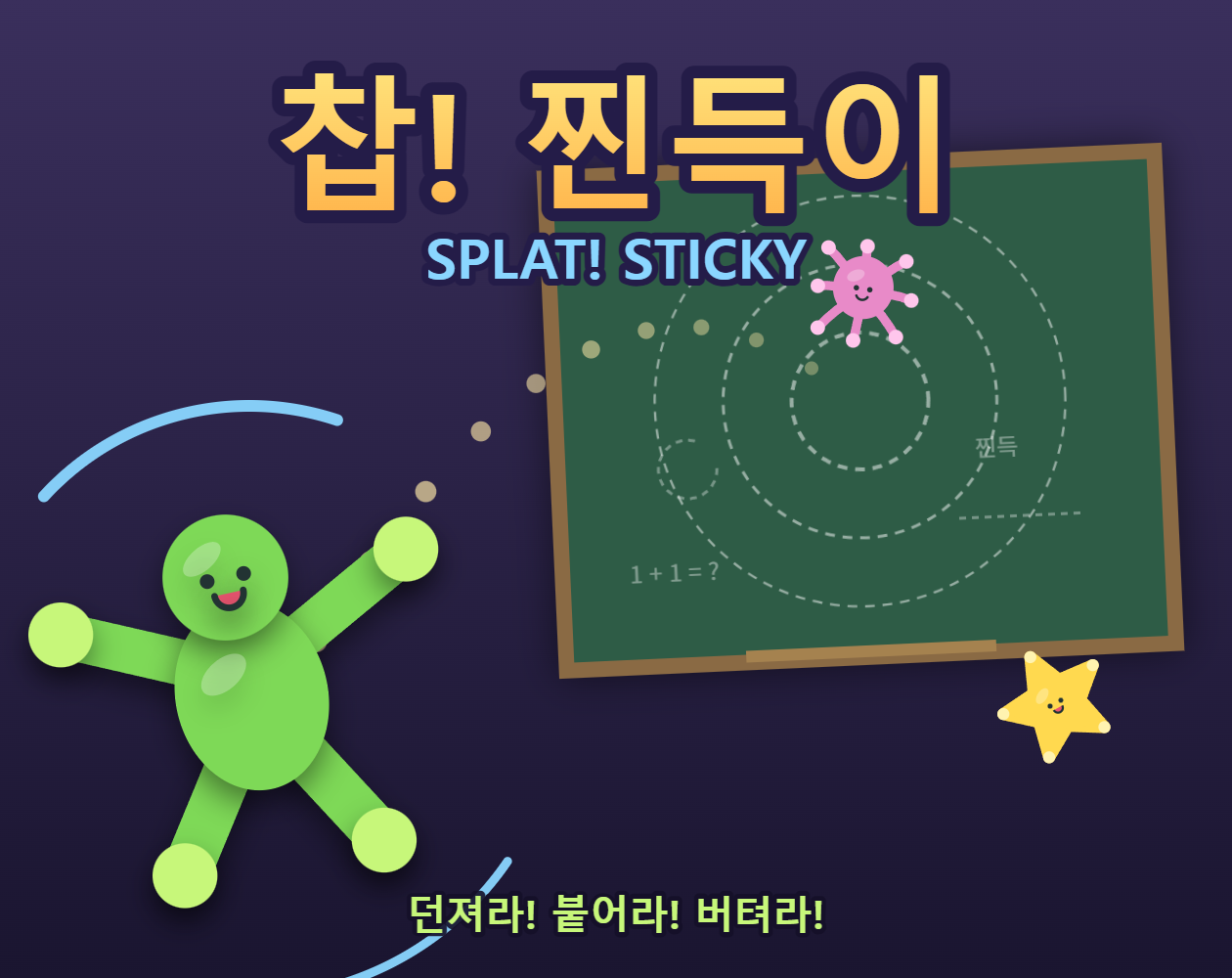
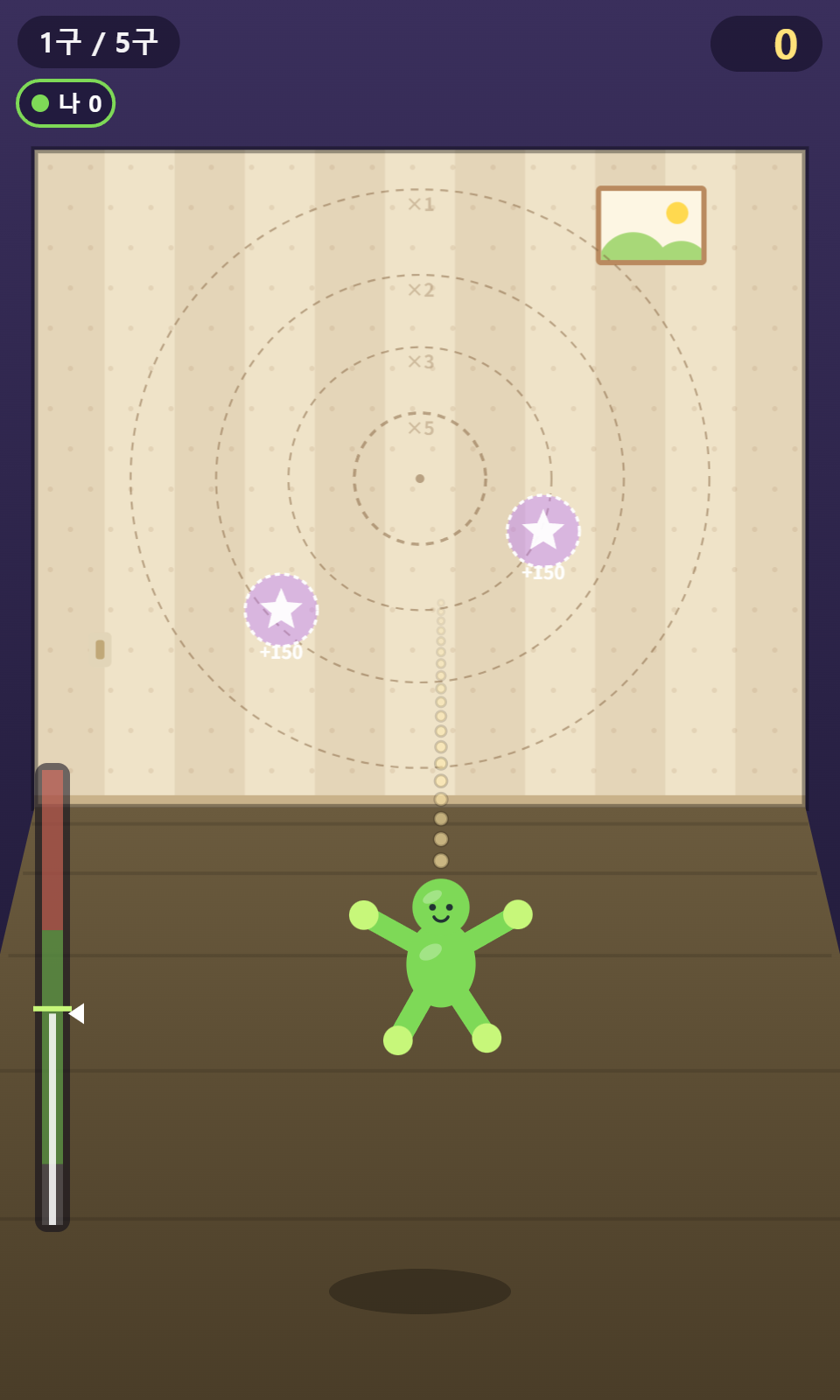
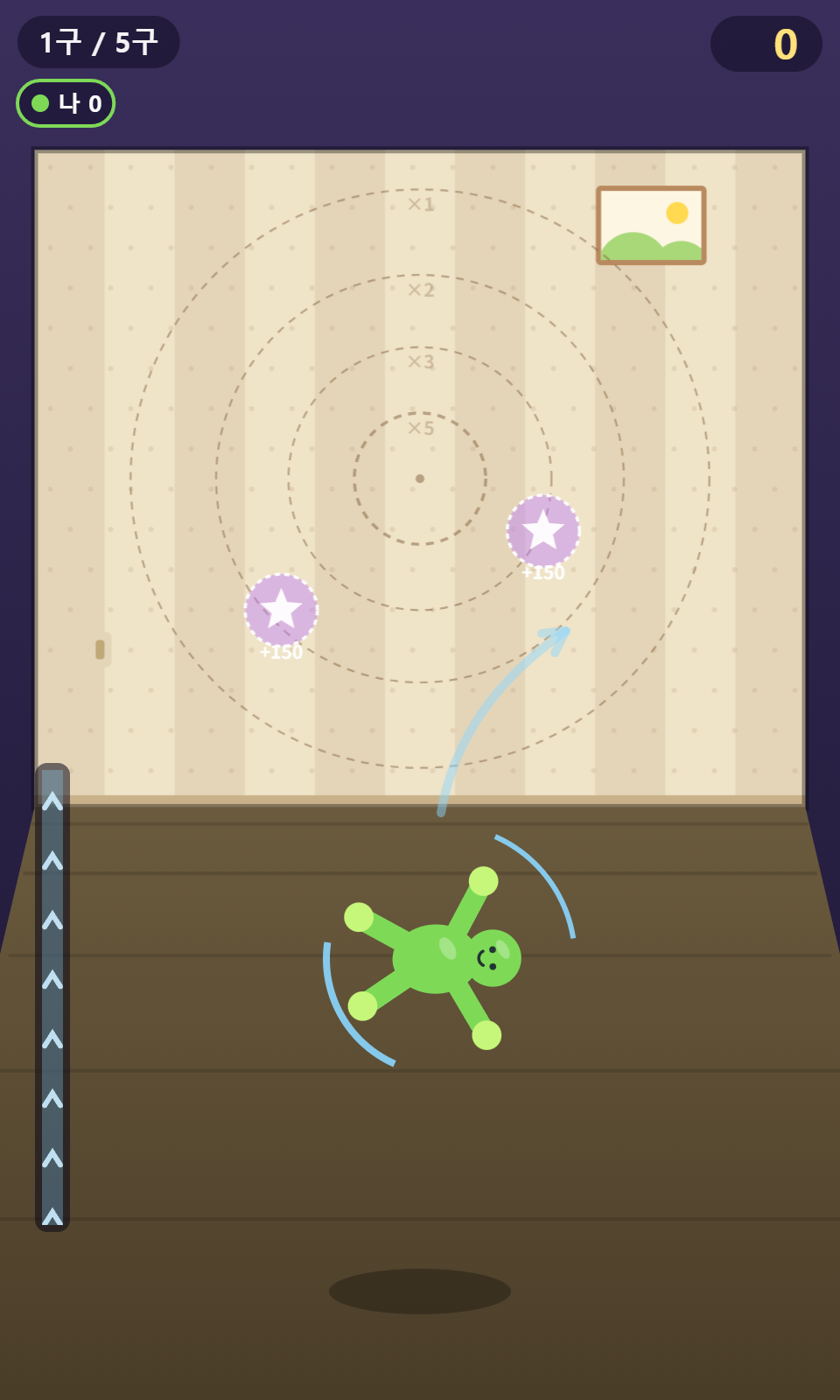
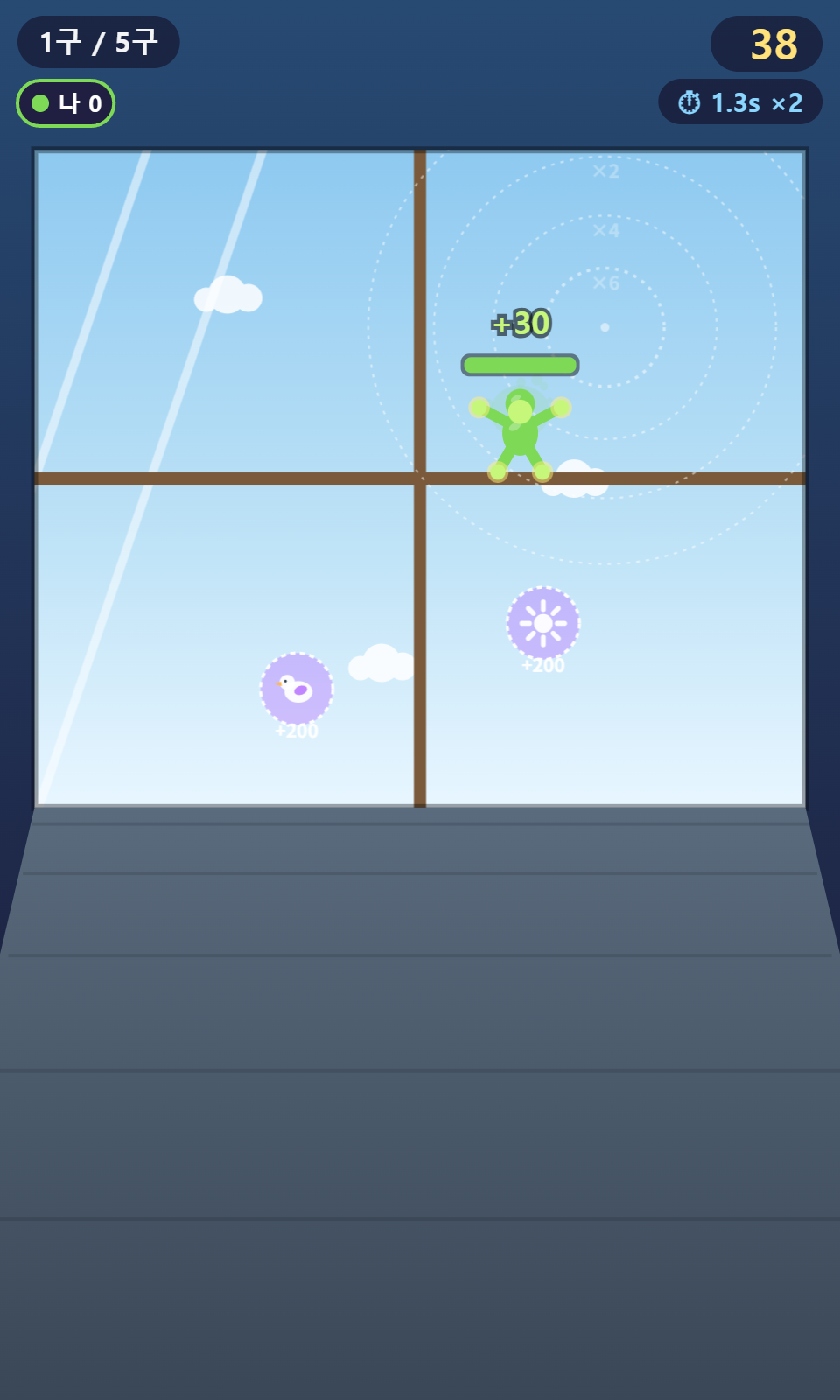
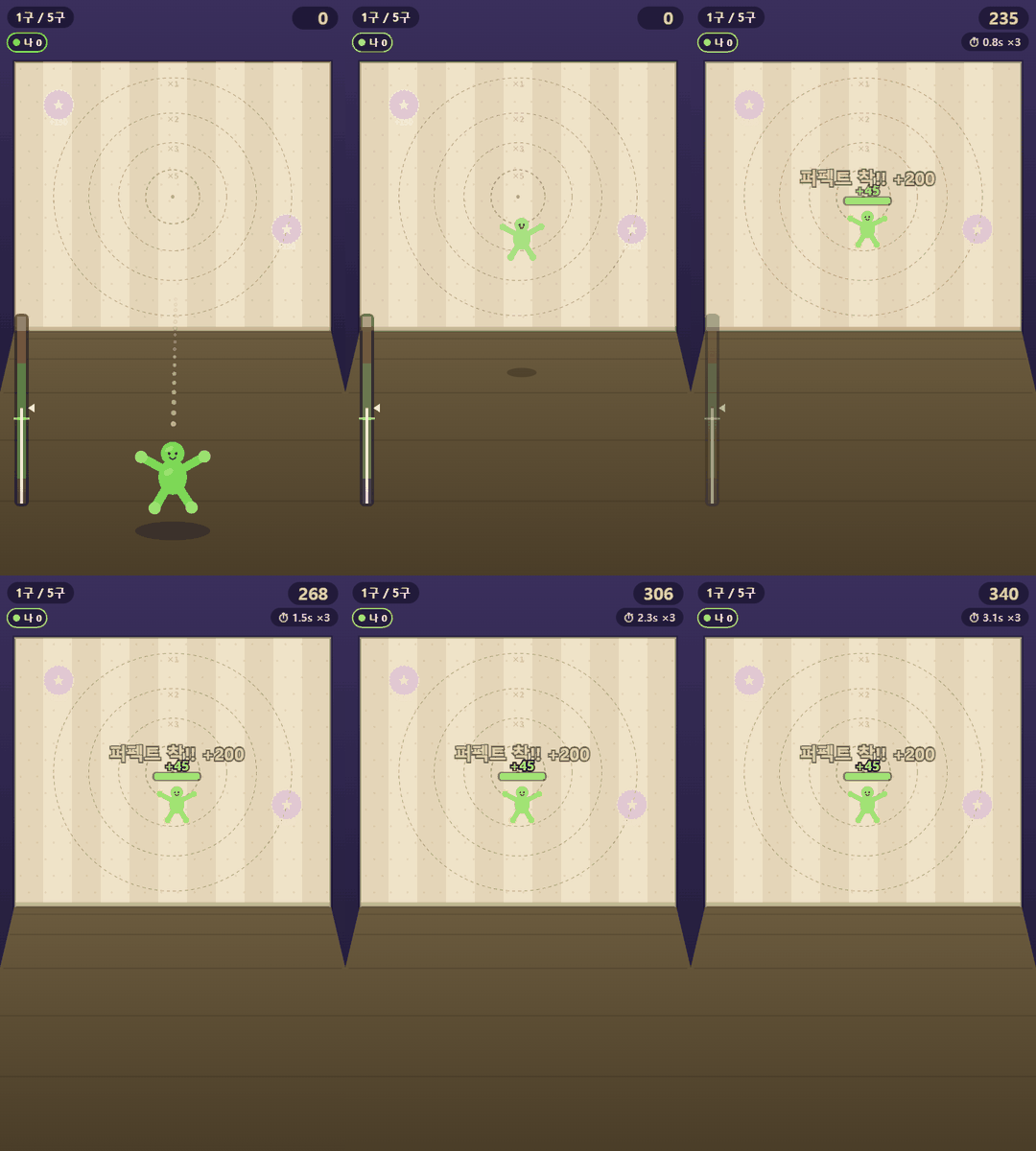
A physics minigame where you flick a sticky toy at a wall, it splats and clings, then slowly tumbles down as its grip wears off. Score = time hung × bullseye-ring multiplier. Add spin on release and the throw curves via the Magnus effect. No engine, no library, no asset files — vanilla JavaScript + HTML5 Canvas, graphics drawn in code, audio synthesized with WebAudio. A 2026 Minigame Makers Challenge entry, shipped on itch.io and Google Play (internal).
At a glance
| Property | Value |
|---|---|
| Engine | None — vanilla JavaScript + HTML5 Canvas |
| Runtime dependencies | 0 (graphics code-drawn, audio WebAudio-synth → runs from file:// by double-click) |
| Modules | 12 JS modules loaded in dependency order (no cycles) |
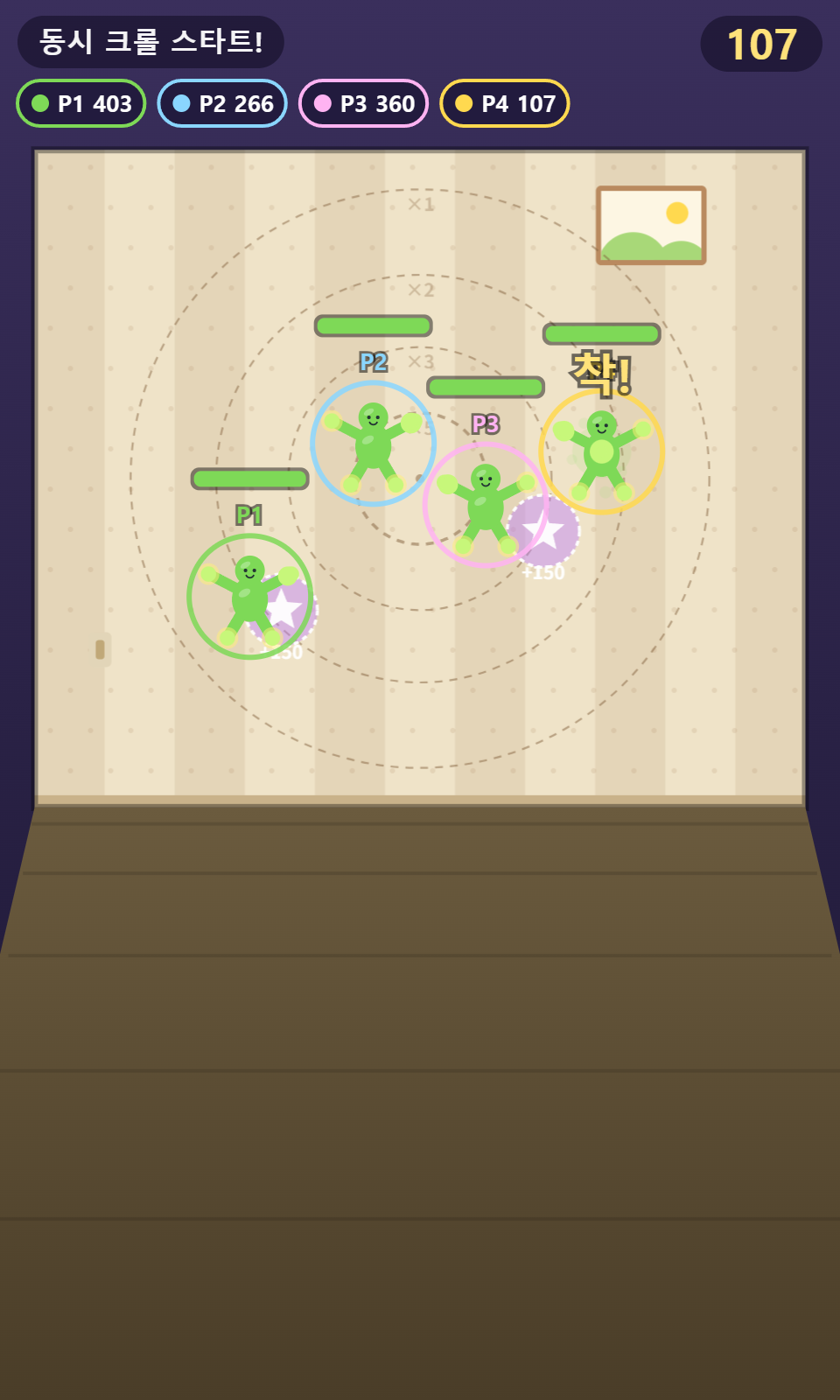
| Modes | Practice (5-throw rounds + localStorage leaderboard), Party (2–8 player hot-seat) |
| Content | 3 toys (man/octo/star) · 4 walls (chalk/room/glass/fridge) |
| Mobile packaging | Capacitor 8.5 → Android AAB |
| Deployment | Tag-driven GitHub Actions → itch.io (butler) + Google Play (internal) · v1.0.1 |
Architecture
12 JS modules stacked in one dependency direction (lower calls higher, no cycles). No build step — plain <script> tags register onto a window.ST namespace in order. Gameplay branches through two state machines: the throw flow (idle→aim→fly→…) and, once stuck, the adhesion phase (settle→hold⇄roll→peel→fall).
Four coordinate systems are kept distinct — world (meters), wall-normalized, a 480×800 virtual screen, and shape-local. Physics runs only in world coordinates regardless of resolution/aspect; rendering projects to the virtual screen.
Deterministic physics: same landing at 60/90/120/144 Hz
The core requirement of a physics minigame is that the same throw always lands in the same place. If the landing point drifts with frame rate or a hitch, a skill game becomes a luck game. stepFlight accumulates frame time and integrates in exact 1/120 s steps, then linearly interpolates to the wall plane so the collision state is decoupled from frame length.
// game/js/physics.js — fixed-timestep accumulator
f.acc = (f.acc || 0) + dt;
while (f.acc >= H_STEP - 1e-9) {
  f.acc -= H_STEP;
  const h = H_STEP;                            // exactly 1/120 s
  const px = f.x, pz = f.z;                     // keep pre-substep state
  f.vy -= TUNE.GRAVITY * h;
  f.vx += TUNE.MAGNUS * f.spin * f.vz * h;      // Magnus curve
  f.spin *= 1 - TUNE.SPIN_DECAY * h;
  f.x += f.vx * h; f.y += f.vy * h; f.z += f.vz * h;

  if (f.z >= TUNE.WALL_Z) {
    // interpolate to the wall → landing pos/vel independent of frame length
    const u = f.z > pz ? (TUNE.WALL_Z - pz) / (f.z - pz) : 1;
    f.x = px + (f.x - px) * u;
    // … y / vx / vy / angle / spin interpolated by u too …
  }
}
An early version scaled the step count to the frame, which produced a “100 ms hitch shifts the landing 2 cm and the toy bounces off the glass window frame” bug. An adversarial review (R15) reproduced it; after switching to fixed step + interpolation, I verified Δ=0 landing coordinates across 5,280 cases at 60/90/120/144 Hz (bit-identical).
Inverted-pendulum topple: descent emerges from physics
The toy’s fall is real rotation, not an animation curve. It pivots about the pad that’s still stuck, tilts like an inverted pendulum, accelerates as it tilts, and re-sticks lower down — you watch the “grip juice” get spent.
// game/js/sticky.js — _updateRoll (inverted-pendulum rotation)
const acc = (9.8 / V2.ROLL_L) * Math.sin(Math.min(R.phi + R.nudge, Math.PI / 2));
R.vel += acc * dt;
let d = Math.min(0.3, R.vel * dt);              // per-frame rotation cap (stability)
R.phi += d;

const a = d * R.dir;                            // real rotation about the pivot
const c = Math.cos(a), s = Math.sin(a);
const dx = st.x - R.pivot.x, dy = st.y - R.pivot.y;
st.x = R.pivot.x + dx * c + dy * s;
st.y = R.pivot.y - dx * s + dy * c;
st.angle += a;
On top of this sits a per-pad grip model (deterministic geometry factor + quality-linked jitter + discrete hold-slip events), so the collapse order differs on every throw. That’s why the same wall and toy still read as a different sequence each round.
No engine, no assets
Zero runtime dependencies, on purpose.
- All graphics are code-drawn — 3 toys and 4 walls are Canvas paths. Zero image files.
- All sound is WebAudio synth — zero audio files. Copyright-clean, near-zero footprint.
- No build step — double-click
game/index.htmland it runs, even fromfile://.
This drives file size and copyright risk to zero, while mobile is just a Capacitor wrapper that emits an AAB — a simple pipeline.
Screenshots
Deployment
Pushing a tag triggers GitHub Actions to (1) upload the web build to itch.io via butler, and (2) ship the Capacitor-wrapped Android AAB to the Google Play internal track. Web and mobile share the same vanilla-JS core, so one codebase serves both platforms with no porting cost.
Decisions worth calling out
- No engine. A single minigame doesn’t need a Unity/Godot runtime. I traded that for instant load, copyright-clean assets, and a tiny footprint — at the cost of hand-writing the physics, rendering, and audio.
- Determinism first in physics. A skill game must be frame-rate-independent. Fixed timestep + interpolation buys bit-identical reproducibility.
- An adversarial review loop. Balance and determinism bugs were reproduced and fixed over review rounds R9–R16; the commit history carries the trail.
Try it
The itch.io button plays it right in the browser, and the full source is public on GitHub.
- JavaScript
- HTML5 Canvas
- WebAudio
- Capacitor
- GitHub Actions